
Small businesses today run on multiple applications. Accounting software, CRM tools, invoicing platforms, document storage, communication apps, and project management systems. Each solves a specific problem. Few talk to each other.
The result is fragmented operations, wasted time, and mounting frustration.
The Fragmentation Problem
Client information sits in one system. Financial data in another. Communications scatter across email and messaging platforms. Getting a complete view of any relationship means jumping between multiple applications.
Most businesses don't use these tools fully. Features go unexplored because managing the collection consumes available time. Data gets entered multiple times. Updates in one system don't reflect in others. Teams spend more time maintaining technology than doing actual work.
The Real Costs
Time is the obvious loss. Application switching breaks concentration. Duplicate data entry creates errors. Manual updates waste effort that should be automated.
The deeper costs matter more.
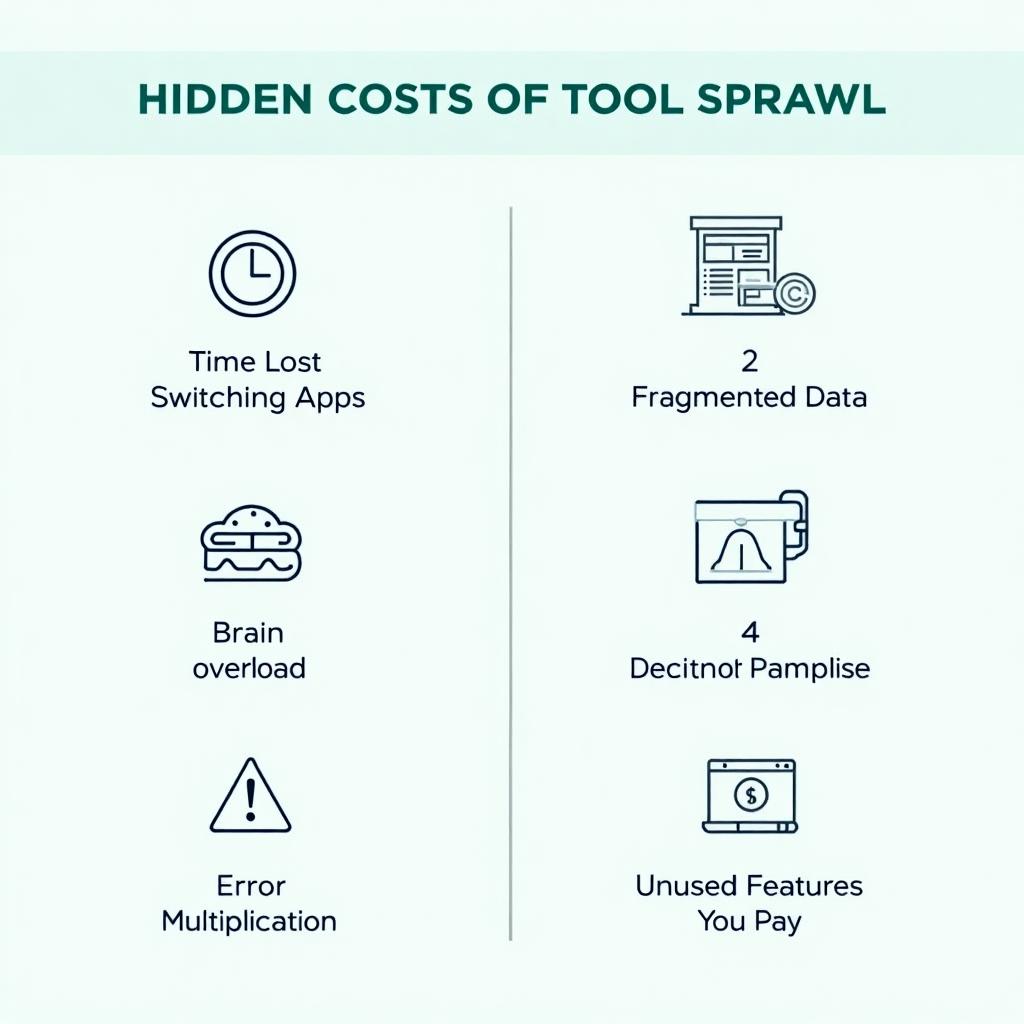
Fragmented data undermines decision-making. Identifying profitable clients, tracking project budgets, or understanding resource allocation requires manual compilation of scattered information.
Teams develop workarounds, learning which system holds which data. Simple questions need complex answers.
Most applications offer automation and integration features. Using six tools at partial capacity means those capabilities go unused. Promised efficiency becomes an administrative burden.
Manual data entry multiplies errors. Information updated in one place but not another. Mismatched numbers between systems. Small discrepancies compound into significant problems.
How It Accumulates
Tool sprawl isn't intentional. It happens through logical decisions made individually.
Basic accounting software comes first. Then a CRM because accounting doesn't handle customer relationships. Then project management because neither tracks work effectively. Then communication tools. Then document storage.
Each addition makes sense alone. The problem emerges from the total.
Integration Limitations
Applications promise integration. In theory, they should connect seamlessly. In practice, integration often means basic data syncing that doesn't address core problems.
Some integrations work partially. Others require technical expertise most small businesses don't have. Some create new problems—unexpected syncing behaviour, duplicate records, and failed connections.
More applications mean more complex integration. Each connection requires maintenance and introduces potential failure points.
The Hidden Tax
The original purpose of business technology was to enable work, not become work itself. But tool sprawl reverses that equation.
Teams become accidental system administrators, troubleshooting quirks and maintaining workarounds. Energy that should go to serving clients goes to managing software instead.
What Changes
The solution isn't adding more applications. It's evaluating what's needed versus what's accumulated.
Some businesses need consolidation—fewer, more comprehensive tools. Others need proper integration so data flows automatically. Some are paying for applications that could be eliminated.
Assessment is the starting point. What are the core processes? What information must flow between teams? Where does unnecessary manual effort occur? Which tools get used versus which just get paid for?
The question for small and mid-sized businesses: Is technology serving the business, or is the business serving its technology?
Related reading: Discover business automation services or read about what happens when systems fail.